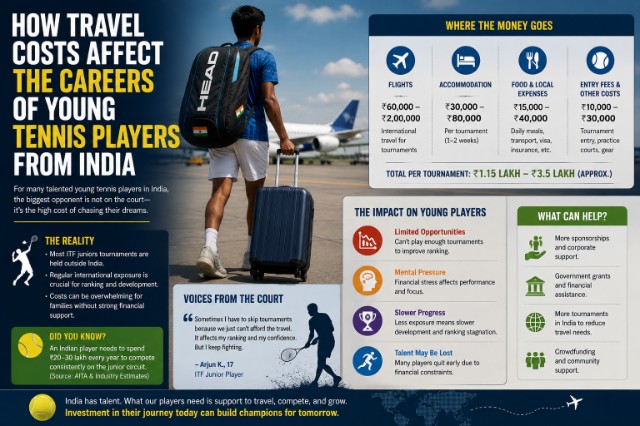
For a young tennis player from India, talent is only one part of the path toward a professional career. Unlike athletes in sports with centralized leagues, tennis players must travel from event to event, often across countries and continents, to collect ranking points and face stronger opposition. The cost of that movement can determine how many tournaments a player enters, which events are chosen, and how quickly development progresses.
Fans may encounter vortex aero login while moving between sports coverage and other forms of online entertainment, but for a young player, international travel is a structural issue. Flights, hotels, visas, food, local transport, coaching fees, and recovery costs accumulate before a player earns enough prize money to offset them. This creates a career model in which financial capacity can influence competitive opportunity almost as much as early results.
Geography Creates a Built-In Cost Disadvantage
India has a large domestic tennis population, but many ranking opportunities are distributed across different regions of the world. A player seeking a consistent schedule may need to travel through Asia, Europe, the Middle East, or other tournament clusters.
For a player based near several events, moving between tournaments can involve a train ride or short flight. An Indian player may first need a long international journey before entering the same circuit.
This affects planning. One tournament rarely justifies the cost of travel, so players often try to enter several events in one region. If they lose early, however, they may spend days waiting for the next tournament while continuing to pay for accommodation and training.
Geography therefore affects both direct expenses and the efficiency of the calendar.
Tournament Choice Becomes a Financial Decision
Ideally, a young player would choose tournaments based on surface, competition level, development goals, and ranking opportunity. In practice, travel cost can become the first filter.
A player may select three events in one country because the total trip is affordable, even if another tournament elsewhere offers a better competitive fit. Entry lists also create uncertainty. A player may travel expecting a place in the main draw but enter qualifying instead.
This makes scheduling difficult. Coaches must weigh the probability of earning ranking points against the full cost of attendance.
As a result, two players with similar ability may build very different schedules. The one with greater financial support can chase more opportunities and recover faster from poor results.
Early Losses Are More Expensive Than They Appear
A first-round defeat affects more than ranking progress. It can make an entire trip financially inefficient.
The player has already paid for transport, visa processing, accommodation, equipment, and preparation. If the event produces little or no prize money, most of those costs remain uncovered.
Several early losses in succession can therefore create pressure to change the schedule or return home.
This is one reason professional tennis can punish inconsistency so severely at lower levels. A player may be improving technically while losing money because results have not yet reached the level needed to fund continued competition.
The financial system can force a promising player to reduce exposure before development has had time to produce results.
Coaching Travel Adds Another Layer of Cost
Young players often benefit from having a coach at tournaments, especially during the transition from junior to professional tennis.
The coach can review opponents, manage training, adjust tactics, and help the player understand why a match was won or lost. However, taking a coach abroad can nearly double some travel costs because another flight, hotel room, meal budget, and local transport must be covered.
Many players therefore travel alone or share coaching support with others.
This reduces cost but changes development. A player may finish a match without immediate technical feedback or may need to prepare for the next opponent independently.
Learning independence is useful, but being forced into it too early because of cost is different from choosing it as part of a development plan.
Visa Requirements Add Time and Uncertainty
International competition often requires more than buying a ticket. Players may need visas, supporting documents, appointment slots, insurance, and proof of travel arrangements.
The process adds fees, but the larger problem can be uncertainty.
Tournament entry lists change close to the event. A player may not know whether entry is confirmed until after travel documentation must already be arranged. Applying too late risks missing the event, while applying early may mean paying for plans that later change.
Visa limits can also affect how long a player remains in one region or how many events can be grouped into one trip.
This makes scheduling more complicated for players who already have limited financial flexibility.
Prize Money Does Not Immediately Solve the Problem
Professional tennis can generate high earnings at the top, but young players usually begin far below that level.
At lower-level tournaments, prize money may not cover the full cost of travel, coaching, accommodation, and preparation. Even a player who wins matches can finish a trip with little financial gain.
This creates a difficult transition period. Players need to compete internationally to improve their ranking, but they often need financial support before that ranking generates enough income to sustain the schedule.
The system therefore rewards players who can survive the early years.
Talent matters, but financial endurance matters as well.
Limited Budgets Can Reduce Match Volume
Match experience is central to development. Young players need repeated exposure to different opponents, surfaces, tactical styles, and pressure situations.
A restricted budget can reduce this volume.
Instead of playing twenty or more events, a player may be able to afford only a smaller number. One injury, illness, or poor stretch of form then has a larger effect because there are fewer opportunities to recover ranking points.
Reduced tournament volume also slows adaptation. A player may train well at home but face fewer situations that require solving problems under match pressure.
This can create a development gap between players with similar technical ability but different access to competition.
Travel Fatigue Can Reduce the Value of the Trip
The cost of travel is not only financial. Long journeys affect sleep, recovery, nutrition, and training quality.
A player may arrive after several flights, change time zones, and have only a short period before qualifying begins. Even if the trip is affordable, poor recovery can reduce performance.
Budget limits can make this worse. Cheaper flights may involve long connections, while less expensive accommodation may be farther from the venue.
These decisions are rational financially but can create performance costs.
Players with larger support teams can manage recovery, transport, and nutrition more effectively. Young athletes traveling with limited resources often have to manage all of these tasks themselves.
Sponsorship Can Change Career Trajectory
Financial support is most valuable before a player becomes widely known.
A sponsor, federation, academy, or private backer can fund tournament blocks, coaching travel, medical support, and recovery. This allows the player to build a schedule based on development rather than immediate affordability.
Stable support also reduces pressure after losses. The player does not have to treat every match as a test of whether the next trip can be funded.
However, sponsorship often follows results. This creates a circular problem: players need results to attract support, but they may need support to access enough tournaments to produce those results.
Breaking that cycle is one of the main challenges in player development.
Domestic Tournament Depth Can Reduce the Burden
One way to reduce travel dependence is to create more ranking opportunities closer to home.
If young Indian players can face strong fields without repeated international flights, they can gain match experience at lower cost. This does not remove the need to travel, because international competition remains important, but it can delay expensive trips until the player is better prepared.
Domestic events can also attract foreign players, creating different tactical challenges without requiring every local player to leave the country.
A deeper regional calendar improves the economics of development.
Travel Costs Shape Opportunity, Not Just Convenience
For young tennis players from India, travel expenses influence far more than comfort. They affect tournament choice, coaching access, match volume, ranking progress, recovery, and the amount of time a player can remain in the professional system.
A talented athlete may need years before results become financially sustainable. During that period, every trip is an investment with uncertain return.
This means career development cannot be evaluated only through rankings or match results. Analysts and federations should also consider how many opportunities a player can realistically afford to pursue.
The difference between a promising junior and an established professional may sometimes be technical or psychological. In other cases, it may be the ability to keep traveling long enough for improvement to become visible.

