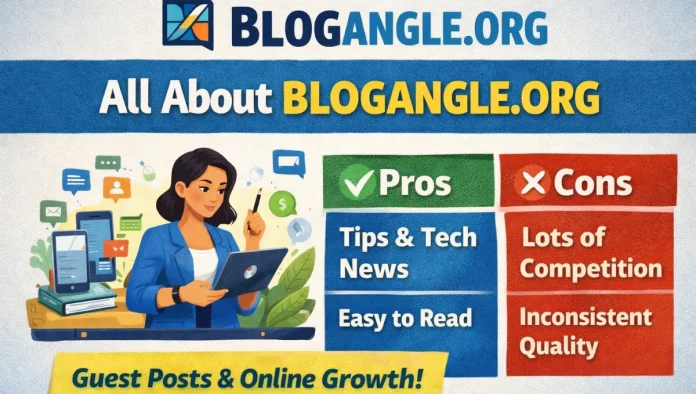
You land on Blogangle.org from one of three directions. You searched a tech or lifestyle question and one of its articles ranked. You’re a blogger looking for a free place to publish and get indexed. Or you’re evaluating it as a guest-posting option for SEO.
Every search path gets you the same set of surface-level reviews feature lists, category breakdowns, and a polite “it’s decent for beginners” verdict. But here’s the real problem: none of them tell you what kind of user you actually are, and that changes everything about whether this platform helps you.
What Is Blogangle Org?
Blogangle.org is an open, multi-niche content publishing platform covering technology, business, finance, lifestyle, gaming, health, and general how-to guides. Writers create accounts, submit original articles, go through a review process, and once approved, get published and indexed by search engines. Content stays live long-term rather than disappearing the way social posts do, which is the platform’s core structural pitch to writers and brands.
For readers, it functions like a typical content site: browsable categories, searchable articles, regular new posts. The homepage promises “the latest tips and tricks to grow fast” across technology, finance, gaming, and entertainment.
How the Open Publishing Model Actually Works
Why Content Quality Varies So Much
Most reviews simply note that quality is inconsistent across the site. Almost none explain why.
Blogangle accepts submissions from multiple, largely independent contributors. Each writer brings different expertise, different research habits, and different incentives. Some are building genuine authority in their niche. Others are placing content purely to secure a backlink. That structural reality means quality isn’t a bug in the system. It’s a natural byproduct of the model itself.
A platform accepting broad submissions across finance, health, tech, and lifestyle simultaneously cannot realistically apply the same depth of fact-checking that a specialized, single-editor blog would. What people assume is: “the article got approved, so it must meet a quality bar.” What’s actually true is that approval on open platforms like this usually checks for originality and basic relevance, not technical accuracy or depth.
This distinction matters more than it sounds. It changes how much trust you should place in any single article, and it explains why one post can feel genuinely useful while the next feels thin and generic.
Reader, Writer, or Brand: Three Different Realities
If you’re a reader, treat Blogangle as a starting point for casual learning, not a definitive source, especially on finance, health, or security topics. Cross-check anything with real financial or medical stakes against established, expert sources before acting on it.
If you’re a writer, the platform gives you a free place to build a portfolio and get indexed content without hosting your own site. The upside is real, but your growth depends entirely on your own research quality. The platform provides audience access, not editorial elevation. It won’t make a weak article strong.
If you’re a brand or SEO buyer, this is where caution matters most. A backlink here carries limited authority weight given the site’s mixed content quality and lack of visible editorial standards. It can support a broader, diversified link profile, but it should never be your primary or highest-value placement.
Read Also:- Yosin TV Live: Watch Free Cricket & Football Matches, Playing XI, Live Scores
The Transparency Gap and What It Means for You
Independent reviews consistently flag that Blogangle.org doesn’t publicly display detailed ownership or editorial team information. The site’s About Us page is just a few lines pointing visitors to “read this information before navigating.”
What does that actually mean in practical terms? You can’t verify who fact-checks health or finance content. You can’t easily hold anyone accountable for inaccurate claims. Long-term site reliability, meaning whether it will still exist and rank in two years, is harder to predict without visible backing.
This isn’t automatically a red flag. Plenty of newer content sites operate this way while they build reputation. But it does mean you should treat every claim on the site with the same skepticism you’d apply to an anonymous forum post, not a piece from an established, accountable publication.
A Quick Trust Test Before You Rely on It
Before submitting content or citing an article from Blogangle.org, a few quick checks go a long way.
Search for the specific claim or statistic elsewhere. Does an established source confirm it? Check if the article names a real author with visible credentials, or just a generic byline. Look at how the piece handles nuance. Does it acknowledge risks and limitations, or does it promise guaranteed results, a common pattern in “free followers” or “quick growth” style content that carries real risk if followed blindly. For guest posting specifically, ask whether the placement fits your niche closely enough to justify the effort, given the platform’s broad, generalist nature.
If a piece fails two or more of these checks, it’s best treated as entertainment-level content rather than a reliable reference.
SEO Value vs SEO Risk
Content that stays indexed and searchable long after publishing is a genuine advantage over social media posts that disappear from feeds within days. Free backlink placement across multiple niches also helps diversify a broader content strategy, and the site’s existing multi-niche audience offers some organic reach that a brand-new blog wouldn’t have.
But these upsides come with real trade-offs. Longevity means little if the underlying content itself is thin or generic. Backlinks from a site with mixed editorial standards carry limited authority weight in the eyes of search engines. Audience trust and engagement depth remain largely unverified. And the fact that everything is free often correlates with lighter editorial oversight overall.
The honest verdict: Blogangle.org works best as one small piece of a diversified content or link strategy. It shouldn’t be your flagship placement, your primary information source, or something to lean on for high-stakes topics.
Final Thoughts
Blogangle.org isn’t a scam, and it isn’t a polished authority site either. It sits in the middle ground that most open publishing platforms occupy: genuinely useful for casual reading and portfolio-building, genuinely risky if you treat it as gospel for important decisions.
The smartest way to use it depends entirely on your role. Readers should stay curious but skeptical. Writers should see it as a stepping stone, not a destination. Brands should size their expectations to match a supporting player, not a headline act.
Frequently Asked Questions
Q1. What is Blogangle org?
Ans. It’s an open, multi-niche content publishing platform covering technology, business, finance, lifestyle, and general how-to topics, where writers submit articles for review and publication.
Q2. Is Blogangle org free to use?
Ans. Yes, both reading content and submitting articles as a writer are free, with no complex technical requirements.
Q3. Is Blogangle org reliable for serious research?
Ans. It’s best treated as a starting point for casual learning. For finance, health, or other high-stakes topics, always cross-verify with established, expert sources.
Q4. Can I use Blogangle org for SEO backlinks?
Ans. Yes, but treat it as a supporting link in a diversified strategy rather than a high-authority placement, given its mixed content quality and limited editorial transparency.
Q5. Why does content quality vary across the site?
Ans. Because it’s an open platform accepting submissions from many independent contributors with different levels of expertise, resulting in inconsistent depth and rigor.

