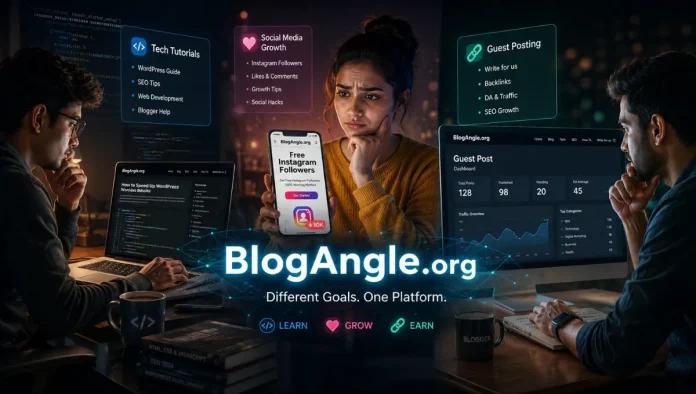
You found blogangle.org through one of three routes. A tech tutorial search. A “free Instagram followers” claim. Or someone in a blogger/SEO group mentioned it as a guest posting target.
Each of those routes leads to the same site but a completely different experience. And the problem with every existing review is that they all describe the same platform as if every visitor has the same goal. They don’t. BlogAngle.org means something different depending on who’s using it. And most reviews either praise it broadly or criticise one narrow feature without mapping the full picture for a specific reader type.
What Is BlogAngle Org? The Three-Layer Reality
BlogAngle.org is not one thing. It is three things operating under one domain and confusing them is why you keep reading vague reviews that don’t actually help you.
Layer 1: Multi-Niche Content Magazine
BlogAngle publishes articles across technology, digital marketing, social media strategy, finance, lifestyle, gaming, health, and general how-to guides. The content is beginner-oriented, easy to read, and wide in scope. Think of it as a general-interest digital magazine for curious readers not a specialist publication.
Layer 2: Social Growth Content Hub
A significant portion of BlogAngle’s traffic comes from articles about Instagram tricks, WhatsApp mods, Android hacks, and social media growth tactics. This is also where the platform’s most controversial claim lives articles about getting 100,000 Instagram followers for free. More on this shortly.
Layer 3: Guest Posting Portal
BlogAngle operates an active “Write for Us” programme. For SEO professionals and digital marketers, the site is primarily interesting as a backlink acquisition platform an opportunity to place content and earn dofollow links on a domain with moderate authority.
What to do now: Identify which of the three layers you actually came here for. Your verdict on BlogAngle.org is entirely dependent on which lens you use and using the wrong lens wastes your time.
Layer 1: The Content Magazine: What’s Actually Good
The general content across technology and digital marketing is BlogAngle’s most consistently useful output.
Tech and App Content
Articles cover app recommendations, Android tips, gadget comparisons, and beginner introductions to tools and platforms. The writing is clear, jargon-free, and formatted for readers with no prior technical background.
What works: The “under-the-radar” app tips that mainstream tech sites ignore niche productivity tools, lesser-known Android features, and practical how-to guides for everyday digital tasks.
What doesn’t work: Depth. At 600–900 words per article, content gives you awareness without the full answer. Useful for discovering a topic; insufficient for mastering it.
Blogging and Content Writing Guides
This is a genuine strength area.
Articles on starting a blog, improving writing, understanding SEO basics, and growing an online audience are practical and well-structured for absolute beginners. If you’re writing your first blog post or trying to understand what “domain authority” means BlogAngle gets you oriented faster than a 4,000-word SEO guide will.
For a first-time blogger, the shorter guide often creates more action than the longer one. BlogAngle’s 700-word “how to pick your blog niche” article will get more beginners to actually choose a niche than Backlinko’s comprehensive 5,000-word version because the shorter one doesn’t overwhelm. That’s a feature, not a bug.
What to do now: If you’re a new blogger or content creator, bookmark the BlogAngle blogging/SEO section as your orientation layer. Read the articles. Identify the specific questions they raise. Then answer those questions on specialist platforms like Ahrefs Blog, Neil Patel, or Moz.
Read Also:- Runvra Com Review 2026: Is This Multi-Topic Blog Safe, Trusted
Layer 2: The 100K Instagram Follower Claim: The Full Truth
This is the section every reader needs before forming any opinion about BlogAngle.org. Articles on BlogAngle frequently discuss “tricks” for gaining 100,000 Instagram followers for free. These articles drive significant traffic to the site. They also carry real risks that no competitor review explains with enough specificity.
What the articles actually involve
The methods described typically involve:
- Third-party follower apps and scripts
- Follow-for-follow engagement loops
- Automation tools that simulate human interaction
What actually happens when you use them
- Some tools temporarily inflate your follower count
- The added followers are almost entirely bot accounts or inactive profiles
- Real engagement (comments, story views, purchases) does not increase because the followers are not real people
- Instagram’s 2026 AI security filters actively detect these patterns
The consequences Instagram applies
- Shadowban — your content stops appearing in hashtag feeds and Explore, silently killing organic reach
- Action block — temporary removal of ability to like, comment, or follow
- Permanent suspension — repeat violations escalate to account removal, with no appeal guarantee
People believe “100K followers” creates brand credibility. Instagram’s algorithm in 2026 weights engagement rate over follower count. An account with 1,000 real followers and 15% engagement rate outperforms an account with 100,000 bot followers and 0.1% engagement in every ranking signal that matters.
Bold opinion: BlogAngle.org’s decision to publish “instant follower” articles without prominent risk warnings is the platform’s most irresponsible editorial choice. The content exists because it drives traffic — not because it helps readers. Using it risks a genuine asset (your Instagram account) for a numerical vanity metric that delivers no real value.
What to do now: Use BlogAngle’s social media content for strategy ideas hashtag research, content calendar planning, Reel format tips. Never use any “instant follower” script or third-party app regardless of which site recommends it.
Layer 3: BlogAngle as a Guest Posting Platform: The SEO Verdict
For digital marketers and SEO professionals, BlogAngle.org is primarily interesting as a link acquisition opportunity.
Here is what the independent SEO audit data shows:
What the independent review found: “BlogAngle.org is an interesting case for SEO pros. It has a respectable Domain Authority and a clean backlink profile. High-speed indexing and a clean, easy-to-navigate interface make it a legitimate outreach target.”
What most SEO users miss: The value of a guest post on BlogAngle isn’t just the DA it’s relevance. A tech or digital marketing article placed here carries contextual authority. A completely unrelated business (a travel agency, a food brand) placing content here for the backlink alone creates weak, potentially diluted link signals. Match your content to the platform’s actual niche for maximum SEO value.
What to do now: If you’re pitching a guest post to BlogAngle.org:
- Review the existing content to understand the tone and depth expected
- Pitch a topic genuinely relevant to tech, digital marketing, or blogging
- Write to the platform’s actual editorial standard not just to manufacture an anchor text opportunity
- Treat it as one node in a diversified link strategy, not a cornerstone link
Is BlogAngle Org Safe to Use?
Yes for browsing.
Independent safety assessment:
- Valid SSL/HTTPS encryption
- Clean domain history — no previous malicious activity
- No aggressive pop-up redirects or malicious ad behaviour
- Content moderation in place — not an AI-spam dump
- No personal data required for reading
- Third-party apps linked in “follower growth” articles may carry their own risks
- Anonymous authorship reduces accountability for claims made
Safety rating: 7/10 safe to browse; cross-reference technical recommendations before acting on them.
What to do now: Use ad-blocking browser extensions when browsing ad-heavy content sites generally. On BlogAngle specifically read the articles freely, but never install any app, script, or tool from a side link without verifying it independently first.
BlogAngle Org vs. Comparable Platforms
| Factor | BlogAngle.org | Neil Patel Blog | Backlinko | HubSpot Blog |
|---|---|---|---|---|
| Beginner-friendly | Strong | Moderate | Moderate | Strong |
| SEO/Blogging depth | Surface | Deep | Deep | Deep |
| Named authors | No | Yes | Yes | Yes |
| Source citations | No | Yes | Yes | Yes |
| Guest posting | Yes | No | No | No |
| Social media growth tips | Broad | Targeted | Limited | Targeted |
| Free access | Yes | Yes | Yes | Mostly |
| Editorial credibility | Low–Medium | High | High | High |
| Best use case | Orientation + guest posting | Strategy | SEO depth | Marketing guides |
Read Also:- Technofee Com Review 2026: Is This Tech Website Legit
Who Should Use BlogAngle Org And Who Shouldn’t
Right for you if:
- You’re a new blogger or content creator who needs plain-English orientation on SEO, writing, and digital marketing
- You’re an SEO professional evaluating moderate-DA guest posting opportunities in the tech/digital marketing niche
- You’re a general reader who wants digestible tech tips, app guides, and digital life hacks without technical depth
- You want free, no-registration content with zero paywall friction
Not the right resource if:
- You want deep, expert-level SEO strategy — use Ahrefs Blog, Moz, or Backlinko
- You’re trying to grow your Instagram following using the “quick methods” — the risk to your account is real and documented
- You need citable sources for professional or academic work — anonymous, uncited content fails this test
- You’re a developer or technical professional needing implementation-level detail
Original Observations
Observation 1: BlogAngle.org’s identity crisis generalist magazine vs. social growth hub vs. guest posting portal — is actually a strategic choice, not an accident. Broad topic coverage maximises traffic. Social growth content captures viral shares. Guest posting monetises authority. The problem is that optimising for all three simultaneously dilutes editorial integrity in each. A platform that tries to be everything to everyone tends to be genuinely excellent at nothing.
Observation 2: The “100K followers” articles aren’t ethically neutral traffic bait. They actively harm the readers most likely to follow the advice beginners with smaller accounts who most desperately want growth and who have the least experience recognising bot follower patterns. The sites that profit from Instagram scam traffic are not neutral participants in the information ecosystem.
Observation 3: BlogAngle’s genuinely strongest content the blogging orientation guides and tech app tips is buried under the louder viral “growth hack” content. If the platform invested its editorial energy in what it already does well, it would be a meaningfully better resource. Instead, it continues to chase the social growth traffic that earns clicks but erodes the trust that makes content valuable.
FAQs About BlogAngle Org
Q1: What is BlogAngle.org?
Ans. BlogAngle.org is a multi-topic content platform publishing articles on technology, blogging tips, SEO, digital marketing, social media strategy, lifestyle, and finance. It also operates as a guest posting portal for content marketers and SEO professionals.
Q2: Is BlogAngle.org safe to use?
Ans. Yes — for standard browsing. The site carries a 7/10 safety rating: valid SSL, clean domain history, no malicious redirects. Caution is advised before installing any third-party tools linked from social growth articles.
Q3: Does BlogAngle.org really give 100K Instagram followers?
Ans. No reliable evidence supports this claim. Methods described typically involve bot followers — which don’t engage with content and trigger Instagram’s AI security filters, risking shadowbanning or account suspension.
Q4: Is BlogAngle.org good for SEO guest posting?
Ans. Yes — conditionally. The site has moderate Domain Authority, a clean backlink profile, and fast indexing. It is a legitimate mid-tier guest posting target for tech and digital marketing niches. Ensure topic relevance for maximum link value.
Q5: Who writes the articles on BlogAngle.org?
Ans. Articles do not carry named bylines. The platform accepts guest contributions via its Write for Us programme, but editorial policy and author credentials are not publicly disclosed.

