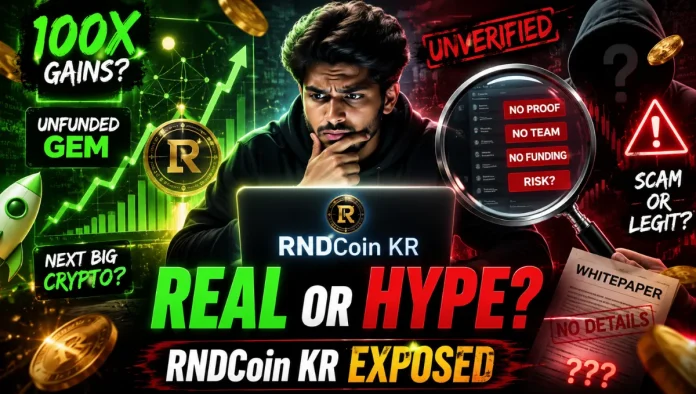
Maybe the combination sounds refreshing in a world drowning in VC-backed ICOs and anonymous pump tokens. Maybe it sounds suspicious. Maybe you’re genuinely trying to figure out what RNDCoin KR actually is before making any decision.
Here’s the immediate problem: every existing article either treats “unfunded” as a marketing virtue without scrutiny or copies the same surface-level description in different words. None of them answer the question that actually matters for a potential participant: What is verifiably real about this project, and what is still unproven?
The First Clarity: What Is RNDCoin KR?
RNDCoin KR is a South Korea–linked cryptocurrency project operating on a self-described “unfunded” model. That means it claims to have launched without venture capital backing, ICO fundraising, token pre-sales, or large private investor allocations.
- Community governance — protocol decisions made openly, not by a central team or investors
- Open-source infrastructure — code publicly auditable and forkable
- Educational content — blockchain learning resources targeting Korean and global users
The project also operates in the context of South Korea’s regulated crypto environment one of Asia’s most active digital asset markets which adds both legitimacy of context and regulatory complexity. Every one of these descriptions comes from the project itself or articles that repeat the project’s own framing. No independent exchange listing data, no third-party code audit results, no verified trading volume, and no confirmed team identity exists in the public domain at this time.
Read this review as a framework for how to evaluate RNDCoin KR not as a verdict that it’s safe or unsafe. The honest answer is: sufficient independent verification doesn’t yet exist to make a confident judgment either way.
The “Unfunded” Model: What It Actually Means
“Unfunded” is RNDCoin KR’s most distinctive and most misunderstood feature.
Here is what the unfunded model concretely means:
- No VC investors — no institutional capital with board-level influence over direction
- No pre-mined insider allocation — early participants hold no privileged token positions
- No ICO or token pre-sale — no fundraising round that creates early-buyer advantages
- No aggressive marketing budget — growth relies on community adoption, not paid distribution
Why This Is Genuinely Different
Most crypto projects follow a predictable cycle: raise capital → issue tokens → early investors exit at retail’s expense. The unfunded model structurally removes that exit-at-retail mechanism. If executed honestly, this creates a fairer distribution. No whale wallets with 3-year token unlock schedules waiting to sell into rising retail interest. No VC firm that needs an 8x return within 24 months.
Why “Unfunded” Is Also a Genuine Risk
Funding is not inherently bad it’s the misalignment of incentives that funding creates that’s bad. Funding itself provides engineering resources, legal compliance capacity, and operational stability. Without it:
- Development depends entirely on volunteer energy — which is unpredictable
- Marketing reach is minimal without budget — adoption is slow
- There is no “safety net” if a critical bug is discovered — no treasury to fund an emergency fix
- Regulatory compliance work — which is significant and expensive in South Korea — has no dedicated budget
Don’t interpret “unfunded” as automatically trustworthy. Ask instead: What is the evidence of sustained development activity? Consistent GitHub commits, community forum engagement, and transparent changelogs over many months are far more meaningful than the absence of VC funding.
Read Also:- Technofee Com Review 2026: Is This Tech Website Legit or Just Another
South Korea’s Crypto Context: Why It Matters
South Korea is not a casual crypto market.
It is one of Asia’s most regulated and actively traded digital asset ecosystems. Korean regulators require:
- KYC (Know Your Customer) verification for exchange participation
- AML (Anti-Money Laundering) compliance for all registered platforms
- Taxation on crypto gains above a threshold
- Registration under the Financial Services Commission (FSC) for exchange operations
RNDCoin KR claims to operate in compliance with these standards.
Korean regulatory compliance is not self-declared — it’s formally documented and publicly verifiable through the FSC registry. If RNDCoin KR is genuinely compliant, that documentation should be findable. If it is not, “compliance” is a marketing claim without teeth. Before participating, search the Korean Financial Services Commission (fsc.go.kr) registry for any registration or acknowledgment of RNDCoin KR. This single verification step tells you more than any review article.
RNDCoin KR Features: What’s Claimed vs. What’s Verifiable
This table is not a verdict against the project. It reflects the current state of independent verification. Absence of public evidence is not proof of dishonesty it may reflect immaturity of the project, limited marketing, or early development stage. But it does define the risk level.
The Tokenomics Question: What No Competitor Explains Clearly
Tokenomics is how value is designed to flow in and out of a crypto project.
For RNDCoin KR, the tokenomics picture involves:
Positives claimed:
- No founder pre-mine — all tokens issued publicly and fairly
- No VC unlock schedule — no institutional sell pressure
- No ICO-era whale wallets waiting to liquidate
What remains unverified:
- Total supply — publicly stated figures not independently confirmed
- Circulating supply — no live data on major aggregators (CoinMarketCap, CoinGecko) at time of review
- Treasury controls — who controls any operational wallet and on what terms is not publicly documented
- Inflation mechanism — how new tokens are introduced (if at all) is not clearly stated in available sources
Assuming “no ICO” means “safe tokenomics.” What matters is the full supply picture total tokens, current circulation, future unlock schedule, and who controls treasury funds. Requesting or locating this information should be your first action before any financial participation.
Ask directly in RNDCoin KR’s community channels: “Can you share the smart contract address, total supply, and treasury wallet?” A project committed to transparency will answer immediately. A project that deflects or redirects to price talk is showing you what it prioritises.
Is RNDCoin KR Genuine Education or Speculative Asset?
One important dimension competitors conflate: RNDCoin KR appears to operate partly as an educational blockchain platform — not purely as a trading token. The BYDFi analysis specifically notes: “RNDCoin is more closely associated with blockchain information and educational content rather than active trading or speculation.”
This dual-identity matters significantly:
- If RNDCoin KR is primarily an educational platform that happens to issue a token for community participation, the risk profile is different from a pure speculative asset
- If the token is the primary product and “education” is a positioning strategy, it is a standard speculative asset wrapped in a learning narrative
The most credible use of a community token in an educational platform is for access, participation, and governance — not for price speculation. If you find RNDCoin KR’s community primarily discussing price charts and “when moon,” the education angle is marketing. If you find it primarily discussing learning resources and governance proposals, the education angle is real.
Red Flags to Evaluate: Before Any Decision
Use this checklist every time you evaluate RNDCoin KR updates:
Technical signals to verify:
- Smart contract address publicly disclosed on official channels
- Code repository with recent commit history
- Third-party security audit from a credible firm (Certik, Hacken, Trail of Bits)
- Bug bounty program in place
- Multisig treasury wallet with time-lock on major transactions
Operational signals to verify:
- Named team members with verifiable LinkedIn or professional history
- Roadmap with specific, time-bound milestones — not vague “coming soon” language
- Transparent incident reporting when problems arise
- Community channels that allow critical questions without ban or suppression
Warning signals to exit on:
- Urgent “buy now” pressure from official channels
- Claims that losses are impossible
- No response to contract address verification requests
- Heavy influencer marketing with no product substance behind it
- Sudden community silence or deleted posts
How to Participate Safely If You Choose To
If, after thorough due diligence, you decide to engage with RNDCoin KR:
- Set a hard risk limit Only allocate capital you can afford to lose entirely. For unverified emerging projects, this typically means 1–3% of your total crypto allocation maximum
- Verify the contract address from multiple official sources before any interaction scam clones appear within days of any project gaining visibility
- Use a hardware wallet for any amount you intend to hold beyond testing (Ledger or Trezor)
- Create a separate “testing” wallet — never test unfamiliar token interactions in your main wallet
- Test with minimum amounts first — small transfer in, verify receipt, then scale only after confirmation
- Store your recovery phrase offline — written on paper, never photographed or saved in cloud storage
- Revoke token approvals after any DEX interaction using tools like Revoke.cash
RNDCoin KR vs. Comparable Korean Crypto Projects
| Factor | RNDCoin KR | Klaytn (Kakao) | BORA | Meta Kongz |
|---|---|---|---|---|
| Backing model | Unfunded, community | Kakao Corp | SK Square | Community NFT |
| Regulatory transparency | Unconfirmed | High (corporate) | High (SK) | Moderate |
| Exchange listings | Limited/unconfirmed | Major exchanges | Mid-tier | Mid-tier |
| Team transparency | Low | High | High | Moderate |
| Development activity | Unverified | Active | Active | Variable |
| Use case clarity | Education + governance | DeFi + gaming | Gaming + NFT | NFT community |
Read Also:- TechTVHub Com Review 2026: Real Truth Behind This Tech Website
Context: Klaytn and BORA benefit from major Korean conglomerate backing, which provides regulatory navigation capacity that an unfunded project explicitly lacks. This isn’t a judgment it’s context for evaluating RNDCoin KR’s structural position in the Korean crypto market.
Original Observations
Observation 1: The “unfunded” label is intellectually honest about funding and potentially misleading about risk. A project with no VC backing isn’t automatically safer for retail participants. The absence of investor exits removes one risk vector but introduces others: under-resourced development, no legal buffer, and community volatility. Framing “unfunded” as a virtue without addressing these tradeoffs is incomplete.
Observation 2: The dual identity of RNDCoin KR educational content platform and tradable crypto token is one of the most interesting and underexplored aspects of the project. Education platforms that issue tokens for access and governance have genuine precedent (Gitcoin, RabbitHole). But the value of the token is entirely contingent on the education platform succeeding as a product first. If there’s no compelling learning experience, the token has no utility anchor.
Observation 3: South Korea’s regulatory regime makes it simultaneously the best and hardest jurisdiction for a crypto project to operate legitimately. FSC registration is demanding but FSC-registered projects carry genuine credibility. RNDCoin KR’s relationship with Korean regulation is the single most important verification point for evaluating its long-term viability. Until that is clearly documented and publicly accessible, every other claim about the project operates in a trust vacuum.
FAQs About RNDCoin KR
Q1: What is RNDCoin KR?
Ans. RNDCoin KR is a South Korea-associated cryptocurrency project operating on a self-described “unfunded” model — meaning no VC backing, no ICO, and no pre-mined token allocation. It focuses on community governance, open-source development, and blockchain education.
Q2: Is RNDCoin KR legitimate?
Ans. Insufficient independent verification exists to confirm or deny legitimacy definitively. The project’s core claims (no ICO, community governance, open-source) are credible in principle but not independently audited at time of writing. Apply thorough due diligence before any financial participation.
Q3: Is RNDCoin KR listed on major exchanges?
Ans. No confirmed listing on CoinMarketCap, CoinGecko, Binance, or Upbit was verifiable at time of this review. Limited or no exchange listing is consistent with an unfunded, early-stage model but also increases liquidity risk significantly.
Q4: What does “unfunded” mean in crypto?
Ans. An unfunded crypto project launches without venture capital, ICO fundraising, or token pre-sales. Development relies on community contributions. While this reduces certain centralisation risks, it also removes the operational resources that funded projects use for engineering, legal compliance, and marketing.

